If you want to go deeper after this article, also read this Application Security roadmap for beginners and the broader cybersecurity and OSINT roadmap.
DevSecOps is one of the strongest career trends in tech. Companies no longer want pure developers on one side and pure security teams on the other, with security blocking releases at the last moment. Business wants engineers who can automate security checks directly inside CI/CD pipelines.
In this article, we will break down why DevSecOps training is one of the best career investments you can make in 2026, which skills are actually in demand on the global market, how much these roles pay in the US and Europe, and how to build a realistic learning plan.
Why DevSecOps became critical in 2026
A few years ago, security often worked in a very old-fashioned way. Developers wrote code, testers checked functionality, sysadmins deployed to production, and only after that security got involved. Then vulnerabilities were found late, releases were rolled back, deadlines slipped, and the business lost money.
In 2026, release speed is dramatically higher. Many companies deploy several times a day. Manual security checks at that pace simply do not scale.
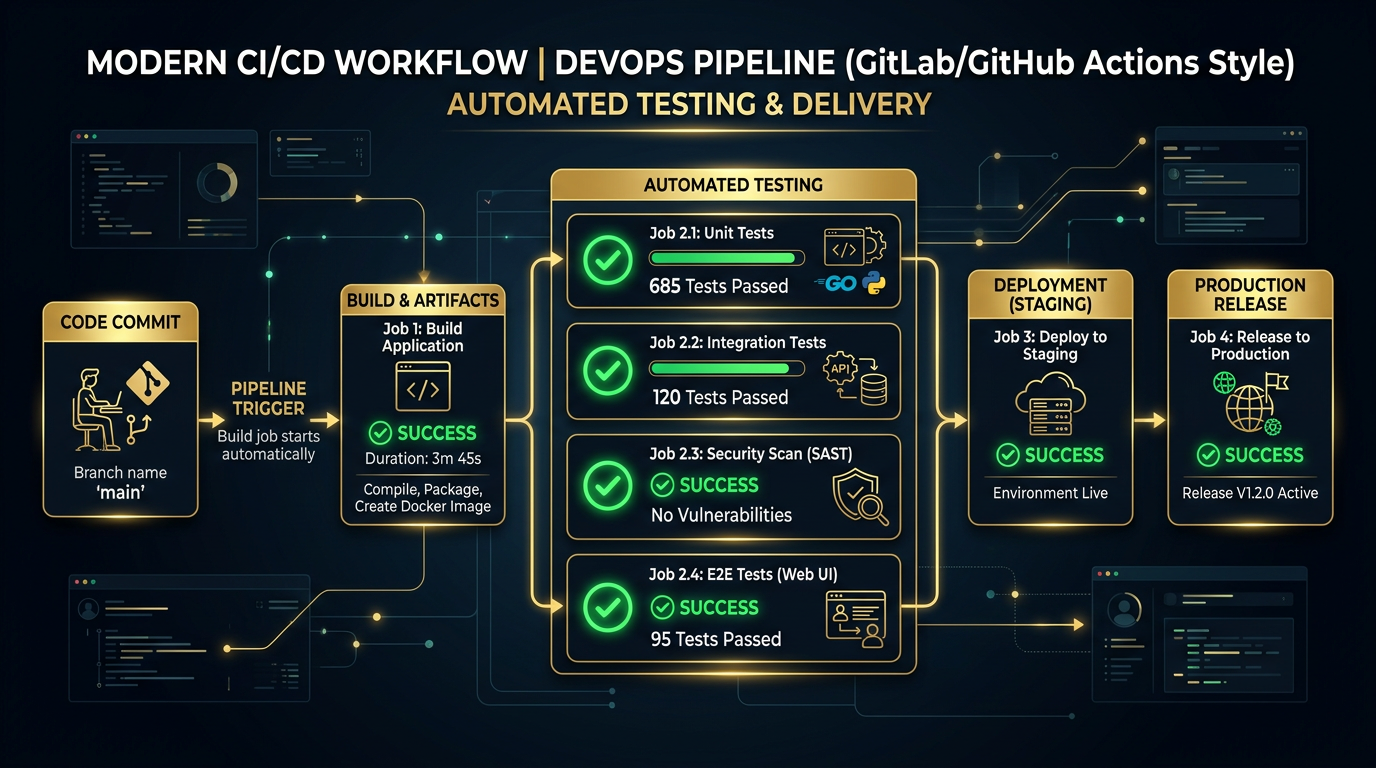
DevSecOps means building security into every stage of software delivery: from the first line of code to monitoring a live application. It is a continuous loop where security controls are embedded into standard automation processes.
The main reasons demand keeps growing:
- Infrastructure is more complex. Microservices, Docker, Kubernetes, and cloud or hybrid environments require ongoing control over configurations. A single bad Kubernetes manifest can expose internal databases.
- Cyberattacks are faster. Automated scanners used by attackers find weaknesses in code and infrastructure quickly, so companies need preventive defenses.
- Regulations are stricter. GDPR, PCI-DSS, and local data-protection frameworks make security failures expensive, so companies are willing to pay well for engineers who prevent them.
Who should move into DevSecOps
DevSecOps is usually not an entry point for people with zero technical background. It is hard to enter “from the street” without understanding operating systems, networking, or automation basics. But it is an excellent growth path for people who already work in tech and feel stuck financially or professionally.
1. QA and SDET engineers
If you work in test automation, write Playwright or Python tests, or run performance checks in JMeter, DevSecOps is a very natural next step. You already know code and CI/CD. The main shift is moving from functional defects to security issues and learning how to automate scanning and enforcement.
2. System administrators and DevOps engineers
DevOps engineers already know how to configure pipelines, build Docker images, and manage Kubernetes clusters. For you, DevSecOps is a strong level-up. If you add threat awareness, dependency vulnerability analysis, and infrastructure security auditing, you move into a much rarer and higher-paid category.
3. Developers
Developers who can write secure code are extremely valuable. If you understand how XSS, SQL injection, or BOLA work from the OWASP world, you can start catching these issues earlier during review and pipeline automation.
How much DevSecOps engineers earn in the US and globally
The market has a real talent shortage here. There are many DevOps engineers and many traditional security specialists, but not enough people who sit exactly at the intersection of both roles. That is why companies in the US and Western Europe are willing to pay aggressively.
Based on current market data from platforms like Glassdoor, LinkedIn, and BuiltIn for 2026, DevSecOps salary ranges in the US often look like this:
- Junior DevSecOps: $90,000 to $120,000 per year, roughly $7,500 to $10,000 per month.
- Middle DevSecOps: $130,000 to $170,000 per year, roughly $11,000 to $14,000 per month.
- Senior DevSecOps / Lead: $180,000 to $250,000+ per year, roughly $15,000 to $21,000+ per month.
That is why serious DevSecOps training often pays for itself after the first one or two salaries in a new role. It is one of the most stable long-term career investments in tech.
DevSecOps roadmap: what to learn
To avoid getting lost in the tool overload, it helps to split learning into clear blocks. You do not have to master every tool at once. First understand the concepts, then apply them in practice.
Stage 1: Core IT foundation
- Linux: terminal work, permissions, networking basics, processes, and logs.
- Networking: TCP/IP, DNS, HTTP/HTTPS, TLS/SSL. You should clearly understand how data moves between client and server.
- Scripting or programming: Python, Bash, or Go for automation and custom checks.
Stage 2: Containers and orchestration
- Docker: build optimized images, reduce attack surface, and scan images with tools like Trivy or Grype.
- Kubernetes: cluster architecture, secrets management, network policies, and secure manifest validation with tools like Kubescape or Checkov.
Stage 3: CI/CD pipelines
You should be comfortable with at least one mainstream automation platform:
- GitLab CI/CD
- GitHub Actions
- Jenkins
The goal is to insert security checks in a way that does not destroy delivery speed unnecessarily, but still blocks truly dangerous issues from reaching production.
Stage 4: Security tools
This is the core of the role. Security tools usually fall into a few major groups:
| Check type | What it does | Common tools |
|---|---|---|
| SAST | Scans source code without executing it to detect risky patterns. | SonarQube, Semgrep, Horusec |
| SCA | Checks open-source libraries and dependencies for known vulnerabilities. | Dependency-Check, Snyk, Trivy |
| DAST | Tests a running application from the outside, simulating attacker behavior. | OWASP ZAP, Nikto |
| Secret detection | Searches for leaked passwords, API keys, and tokens in code or commits. | GitLeaks, TruffleHog |
Stage 5: Monitoring and logging
Security does not end at deployment. You need visibility into what the system is doing in real time:
- Metrics and logs: Grafana, Prometheus, InfluxDB, ELK stack.
- Alerting: the system should notify the team immediately when suspicious behavior or unusual load appears.
How to choose training and avoid common mistakes
Many people try to learn DevSecOps only through free YouTube content or documentation. The problem is not that this material is useless. The problem is the lack of structure. You may spend months learning one tool, such as Jenkins, but still not understand how to connect it to real code security, container scanning, or post-deploy visibility.
What to look for in a serious course or mentorship format:
- Maximum practice. Theory without building a real pipeline is weak. You want a program where you deploy a project, integrate scanners, and configure dashboards yourself.
- Modern stack. Make sure the program includes GitLab or GitHub, Docker, Kubernetes, SonarQube, Trivy, and similar current tools rather than outdated legacy software.
- Real practitioners. The training should be led by people who actually work in the industry, perform real audits, and understand business pressure, deadlines, and technical trade-offs.
Conclusion: make the move into a high-demand role
The IT market is changing. The era where you could simply write code or only click through interfaces is fading. Companies increasingly value cross-functional engineers who can protect the product and automate repeatable work.
DevSecOps training gives you:
- Stable demand, because security is always needed.
- Higher earning potential and stronger competitiveness on US and European markets.
- Interesting technical work at the intersection of development, systems, and cybersecurity.
Do not postpone growth. If you want to build a realistic path into DevSecOps, now is the right time.
A strong next step from here is how SDET and security testing can become a practical entry path plus a hands-on example of security testing in a modern pipeline.
If you want to join a DevSecOps training path and discuss your next steps, message me on WhatsApp.
We can talk through your background, the right sequence of topics, and what you should practice first on WhatsApp.
FAQ
Question: Can I move into DevSecOps with zero IT experience?
Answer: It is extremely difficult. It is better to first get baseline experience in QA, system administration, development, or DevOps, then transition into DevSecOps.
Question: Do I need advanced mathematics or deep cryptography knowledge?
Answer: No. In day-to-day work you mainly need solid networking logic, the ability to read code, and the skill to configure automation and security tooling correctly.
Question: What are the long-term prospects?
Answer: Demand for automated security will keep growing. As more code is produced faster, especially with AI-assisted development, the need for people who can embed reliable security controls into delivery pipelines will remain strong for years.