If you want a broader view of entering tech, also read how to enter IT and choose a career path as a beginner and how to become a DevSecOps engineer from scratch.
The question “how do I become a programmer?” sounds simple. The answer is not. The market is full of people who finished a couple of courses, built one landing page, and expect an offer. Companies still hire beginners — but they hire people who can solve problems, not people who only followed tutorials.
This guide is practical and direct: which languages make sense first, how AI is changing junior requirements, where you can realistically apply, and what most “just learn Python” advice leaves out.
1. What “becoming a programmer” really means today
A programmer is not someone who “knows a language.” A programmer turns a business need into a working solution: understand the requirement, design a piece of the system, write the code, verify it, fix bugs, and ship it.
That is why so many beginners get stuck. They learn syntax, but they never learn product thinking. Employers do not pay for knowing loops and arrays. They pay for outcomes: the feature works, fewer bugs ship, the release stays stable, and the API does not leak other users’ data.
“Programmer” is also an umbrella word. Under it you will find different roles:
- Frontend — interfaces, browsers, user experience.
- Backend — server logic, databases, APIs.
- Fullstack — both sides at a basic/mid level.
- SDET / QA Automation — code that tests other code and products.
- DevOps / DevSecOps — delivery, infrastructure, pipeline security.
- AppSec — application and API security.
If you start with “I just want to be a programmer” and no direction, you usually land in the most competitive funnel: junior frontend/backend with the same resume as thousands of other people. That path is not closed. It just needs a smarter strategy.
2. Which languages to learn and why
The biggest beginner mistake is choosing a language based on this week’s hype. One week everyone pushes Rust, then Go, then Python again. Six months later, you are still shallow everywhere.
Simple rule: pick one main language and one stack around it for at least six months. Add a second language later, once you have a real foundation.
JavaScript / TypeScript — the best start for most people
If you want faster visible results and more market options, start with JavaScript, then move into TypeScript.
- It powers most of the web.
- You can do frontend, backend (Node.js), automation (Playwright), scripts, and even some DevOps tooling.
- There are many jobs and learning resources.
- It is easy to build a portfolio: a site, an API, automated tests, a small service.
The downside: because the entry barrier is lower, there are many beginners around JS. “I watched React tutorials” is not enough. You need projects that show thinking: APIs, error handling, tests, deploy, and basic security.
Python — a strong start if you like logic and data
Python is beginner-friendly: readable syntax, fast progress, strong ecosystem. It fits well if you care about:
- backend and APIs;
- scripts and automation;
- data-related work;
- parts of security tooling.
Same caveat: “I learned Python” means nothing by itself. You need context — Django/FastAPI, SQL, tests, Git, and a real understanding of HTTP.
Java and C# — if you aim at enterprise
Java and C# are strong in large companies, banks, and corporate systems. Those environments often bring more process and stability. But for absolute beginners, the start is heavier: more ceremony, more surrounding tooling, and a longer path to the first tangible result.
Unless you specifically want “bank/enterprise only,” I would not make them your first language from zero. Arrive there later with engineering fundamentals already in place.
What not to pick first
- C / C++ — powerful, but too hard as a first commercial web/product entry point.
- Rust — excellent language, poor first step for most beginners.
- Three or four languages in parallel — a classic way to lose a year.

3. How AI is changing the profession
AI has already changed the job. Just not in the “programmers are obsolete” way clickbait claims.
What actually happened:
- Boilerplate code is written faster.
- Simple CRUD, draft tests, and docs can be generated in minutes.
- The market got tougher on weak juniors: “I can write simple code” is no longer a rare skill.
What AI still replaces poorly:
- business context;
- architecture decisions for a growing product;
- finding non-obvious bugs;
- access control, authorization, and edge cases;
- ownership of production and incidents;
- communication with team and stakeholders.
Bottom line: AI does not kill programmers. It kills the illusion that syntax alone is enough. A strong beginner today uses AI as an accelerator, but still understands what the code is doing.
Practical advice: use AI for drafts, explanations, and refactoring. Then ask yourself: “Can I explain why this works? Can I fix it without ChatGPT? Do I see the risks?” If not, you are copying — not learning.
4. Where beginners can actually get hired
After “which language,” the next question is always “where do I apply?” Here is a realistic map.
1) Classic development: frontend / backend
Still a valid path, but the most competitive one. Your odds improve if you have:
- 2–3 GitHub projects with clear READMEs;
- a real deploy, not only local code;
- tests or at least basic verification;
- the ability to explain decisions in interviews.
Where to look: smaller product companies, startups, outsourcing, and internal IT teams in non-tech businesses. Giant companies with a thousand applicants per junior role are usually a weak first target.
2) QA Automation / SDET — often a smarter entry
Many people undervalue this path. That is a mistake. An SDET writes code every day, works with APIs, UI, CI/CD, and quickly learns how products really behave. Competition is often lower than for “pure” junior frontend.
If you like quality, logic, debugging, and automation, this is one of the most practical routes into tech. I cover the stack in more detail in the article about security testing as a career accelerator for SDET engineers.
3) Security-adjacent roles
Not every beginner becomes an AppSec engineer on day one. But even early on, it helps to learn:
- API and authorization testing;
- a basic pre-release security checklist;
- XSS, IDOR/BOLA, and data exposure risks.
That strengthens any developer or automation resume. Markets increasingly pay not only for “shipped a feature,” but also for “did not cause an incident.”
4) Internships, support+code, junior+ops hybrids
Do not chase only the title “Software Engineer.” A strong start can also be:
- an internship with real tasks;
- a role that mixes code and product support;
- internal automation inside a company;
- small freelance jobs with a clear scope.
Your first job is not about a fancy title. It is about experience, code review, production tasks, and learning how teams work.
5. What to learn beyond the language
Language is only the foundation. This is what separates “I finished a course” from “we can put this person on a team”:
- Git and GitHub — branches, pull requests, readable commit history.
- HTTP and APIs — methods, status codes, headers, JSON, auth.
- Databases — at least SQL basics: SELECT, JOIN, indexing at a high level.
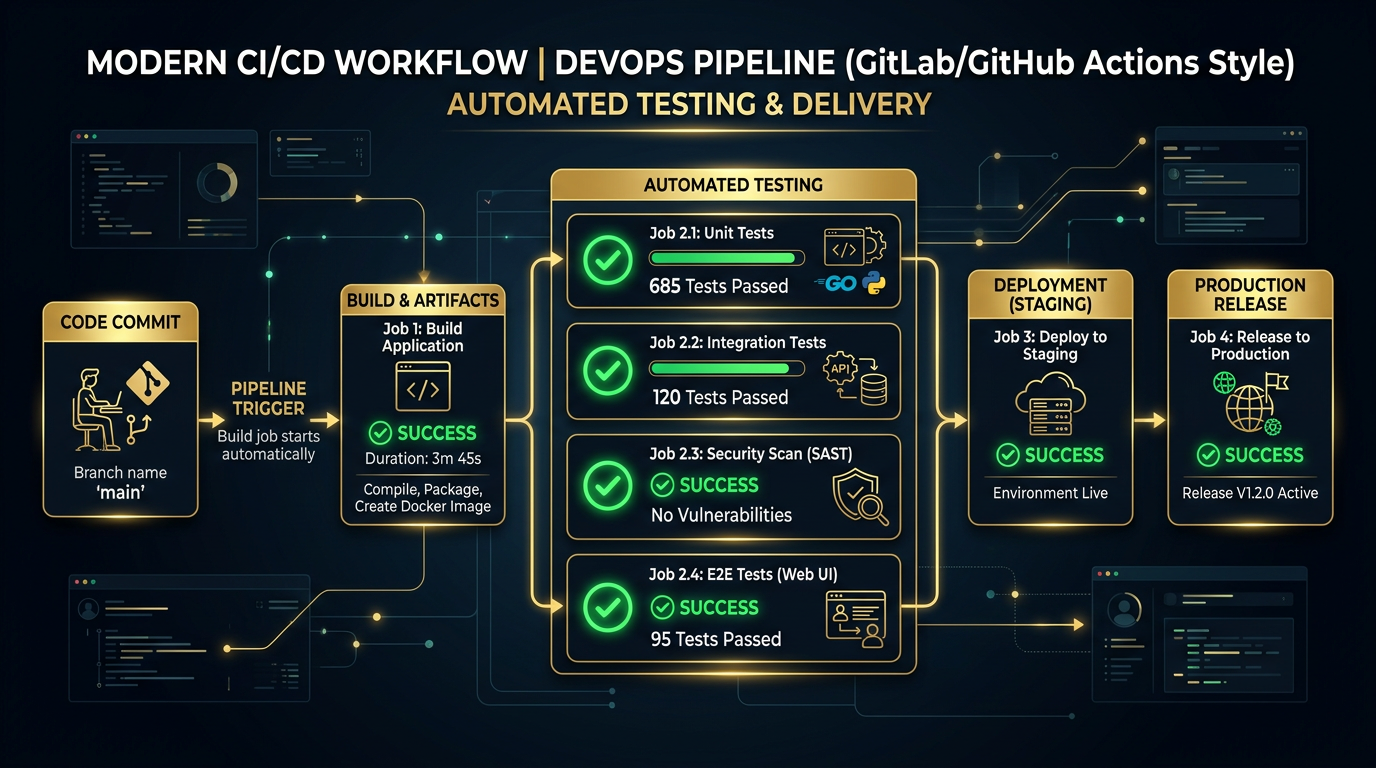
- Testing mindset — unit/integration/e2e thinking, even if you are not QA.
- Linux / terminal — basic commands, logs, permissions, ssh.
- English — docs, Stack Overflow, job posts, interviews.
- Deploy — ship at least one project to Vercel/Render/a VPS.
One more skill I always add from mentoring experience: reading and debugging other people’s code. In real jobs, you spend more time reading and fixing than writing perfect greenfield code.
6. Common beginner mistakes
- Course hopping. Buy one, quit, buy another. After a year — no depth.
- Learning without projects. Notes and certificates do not replace GitHub.
- Perfect plans instead of action. People spend months choosing the “ideal roadmap” and never write code.
- Blind trust in AI. Generate, paste, ship, understand nothing. That is not growth.
- Tutorial addiction. Progress becomes real only when you break and rebuild things yourself.
- Ignoring soft skills. If you cannot explain a solution, you lose offers even with decent code.
- Expecting fast money. Zero to stable mid-level in two months is a fairy tale. Think in 6–12 months of consistent work.
7. A practical 6–12 month plan
Months 1–2: foundation
- Pick a language: JavaScript or Python.
- Learn syntax, functions, data structures, and basic async.
- Learn Git.
- Build 2 small projects without copying a tutorial one-to-one.
Months 3–4: specialization
- Frontend track: HTML/CSS + JS + one framework + API work.
- Backend track: APIs, databases, auth, validation, error handling.
- SDET track: Playwright, API checks, reporting, CI.
Months 5–6: portfolio and job market
- Build one strong “production-like” project: README, deploy, tests, issues.
- Clean up LinkedIn and GitHub.
- Apply selectively instead of spamming every vacancy.
- Write short case notes: what broke, what you fixed, what you learned.
Months 7–12: leveling up
- Add CI/CD, a basic security mindset, and error monitoring.
- Take on a harder pet project or open-source contribution.
- Prepare for interviews: live coding + project walkthroughs.
- If offers are missing — improve the portfolio, do not buy a fifth course.
What I would add as a mentor
After many conversations with people who “want to enter IT,” one pattern is clear. The winners are not always the smartest people or the ones who bought the most expensive course. The winners are people who:
- choose one direction and stick to it;
- ship projects every week;
- can explain decisions in plain language;
- are not afraid of unglamorous work: logs, bugs, docs, review comments;
- treat the craft like a trade, not a lottery ticket.
Another tip courses rarely advertise: you do not have to start as a “pure developer.” Sometimes it is faster and calmer to enter through QA Automation, grow into SDET, and later move into development, AppSec, or DevSecOps. Careers in tech are rarely straight lines. What matters is entering an environment where you write code and solve real problems.
And one last thing: English and communication now give as much leverage as another framework. If you can read docs, ask clear questions, and describe a problem well, you already outrun half of the “I finished a course” candidates.
8. FAQ
How long does it take to become a programmer from scratch?
With 10–15 focused hours a week, a realistic window for a first job is 6–12 months. Faster cases exist, but they are exceptions — not a plan.
Do I need a university degree?
Not necessarily. You need projects, thinking, and the ability to learn. A degree helps in some companies, but it does not create an offer by itself.
Are courses better than self-learning?
What matters is systems. A course can give structure. Self-learning builds independence. Without practice, both are useless.
Should I study algorithms from day one?
Basic data structures — yes. Contest-level algorithms in month one — no. First learn to ship working projects, then deepen algorithms for specific interview tracks.
Conclusion
Becoming a programmer is still realistic. But the path has changed. The winner is not the person who learned the most languages. It is the person who chose a direction, built strong projects, learned to use AI without losing their own thinking, and understands where they are heading on the market.
Pick JavaScript or Python. Build a stack. Ship projects. Learn to explain decisions. Look beyond “junior frontend only” and consider strong adjacent entries — automation, APIs, security. Move consistently. In this profession, growth speed almost always equals the quality of your practice.
Continue with: how to enter IT as a beginner, a cybersecurity and OSINT roadmap for newcomers, and what to do if you are stuck on the path to automation.
Want help choosing a language, track, and learning plan without chaos? Message me on WhatsApp.
For a personal review of your path into programming, message me on WhatsApp.